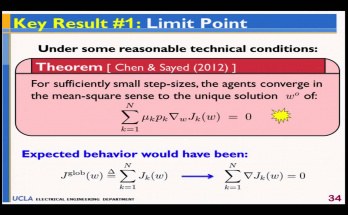
Network science deals with issues related to the aggregation, processing, and diffusion of information over graphs. While interactions among agents can be studied from the perspectives of cluster formation, degrees of connectivity, and small-world effects, the possibility of agents interacting dynamically with one another and influencing each other’s behavior opens up a plethora of notable possibilities and challenges. For example, examining how local interactions influence global behavior can lead to a broader understanding of how localized interactions in the social sciences, life sciences, and system sciences shape the evolution of their respective multi-agent networks. In this presentation, we explain how agents can learn from dispersed information and solve inference and learning tasks of varying degrees of complexity through localized processing and diffusion learning. The presentation explains how information diffuses over graphs, how beliefs are formed, and how the graph topology influences performance. Examples will be considered in the context of social learning, teamwork, and distributed optimization.